


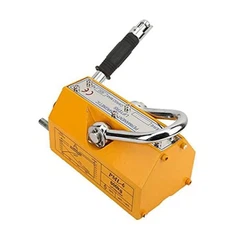
Ferrite magnets are permanent magnets mainly made of SrO or BaO and Fe2O3. Compared to other permanent magnets, ferrite magnets are hard and brittle, with lower magnetic energy. However, it is not easy to demagnetize and is not easy to corrode, the production process is simple and the price is low. Therefore, ferrite magnets have the highest output in the entire magnet industry and are widely used in industrial production.
Ferrite magnets are sintered permanent magnetic materials composed of barium and strontium iron. In addition to strong anti-demagnetization properties, this magnetic material has the advantage of low cost. Ferrite magnets are hard and brittle and require special machining processes. Because the magnets of the opposite sex are oriented along the manufacturing direction, they must be magnetized in the direction taken, and the magnets of the same sex can be magnetized in any direction because they are not oriented, although a slightly stronger magnetic induction is often found on the side under pressure which is the smallest. The magnetic energy product ranges from 1.1MGOe to 4.0MGOe. Due to their low cost, ferrite magnets have a wide range of applications, from motors, speakers to toys and handicrafts, so they are currently the most widely used permanent magnet materials.
Qhov sib txawv nrog NdFeB hlau nplaum
Ferrite magnets are ferromagnetic metal oxides. In terms of electrical properties, the resistivity of ferrite is much larger than that of metal and alloy magnetic materials, and it also has higher dielectric properties. The magnetic properties of ferrites also show that they have high permeability at high frequencies. Therefore, ferrite has become a non-metallic magnetic material widely used in the field of high-frequency weak current. It is a non-metallic magnetic material, which is a composite oxide (or ferrite) of magnetic ferric oxide and one or more other metal oxides. The magnetic force is usually 800-1000 Gauss, which is often used in speakers, speakers, and other instruments.
Qhov zoo ntawm NdFeB hlau nplaum yog cov nqi siab thiab kev ua haujlwm zoo; Qhov tsis zoo yog qhov ntsuas kub ntawm Curie yog qhov tsawg, cov yam ntxwv kub tsis zoo, thiab nws yooj yim rau pulverized thiab corroded. Nws yuav tsum tau kho los ntawm kev kho nws cov tshuaj muaj pes tsawg leeg thiab siv txoj kev kho saum npoo. kev txhim kho, txhawm rau ua kom tau raws li qhov yuav tsum tau ua ntawm kev siv tswv yim. NdFeB belongs rau tiam thib peb ntawm cov khoom siv hlau nplaum tsis tshua muaj hauv ntiaj teb. Nws muaj cov yam ntxwv ntawm qhov me me, lub teeb yuag, thiab muaj zog sib nqus zog. Nws yog cov hlau nplaum nrog qhov kev ua tau zoo tshaj plaws thiab tus nqi sib piv. Qhov zoo ntawm lub zog ntom ntom ua rau NdFeB cov khoom siv hlau nplaum ruaj khov siv dav hauv kev lag luam niaj hnub thiab tshuab hluav taws xob. Nyob rau hauv lub xeev ntawm liab qab hlau nplaum, lub magnetic quab yuam tuaj yeem ncav cuag li 3500 Gauss.


